Saturday, January 2, 2016

Otavalo to Las Peñas

I arrived in Otavalo at about 2pm on the 21st. I had forgotten how much I had liked Otavalo the last time I was in Ecuador. I went to the hotel I was at last year and he gave me the same room overlooking the Imbabura volcano.  I went to the Daily Grind coffee stand and met the owner Bonnie. She hails from NYC but keeps her horses in Virginia. She was an advertising consultant and now gives children the food and educations they require. A very sweet lady. I also met a very handsome gentleman named George who was in Ecuador to climb Cayambe. He aspires to visit every country in the world and climb the highest peaks on each continent. He has accomplished much of that already and will climb Everest this year. He wanted me to confirm that a picture he had taken was, indeed, a condor. It was. I got my bird too. A much smaller tropical doradito which is difficult to find among the reeds of Andean lakes.
I finally bought a Panama hat in Otavalo. The markets are fascinating. The fabrics and colors brighten every corner. I also bought a Quena, which I will learn to play. A musician told me I paid too much and should have bought the bamboo instrument and not the one made of wood. Live and learn.
Christmas was very special in Otavalo.The children's parades and the music was enchanting and calm. I spent the evening listening to Andean music and drinking a local wine.
Birds were on the agenda and one of Ecuadors top birders, Roger Ahlman from Finlandia, told me  where I should visit. The area is called the Chocó region and has birds found only in the NW corner of Ecuador and SW Colombia. Last year the FARC's were farking around and mines were exploding with people on top of them. Things have calmed since then and so I took the bus to Ibarra to spend one night before I set off in a bus for San Lorenzo. Ibarra is very different from other parts of Ecuador. The people seemed very tense and unhappy. The locals asked me if I spoke Castellano, as they do. What? The further north and west I went the more difficult it was to understand them. One night was enough. Let the birding begin!
I took the 8am bus to Gualchan and arrived at Hacienda Primavera by 10:30am. The driver was waiting to take me the rest of the way to the hacienda. The same family has owned the lodge for the last 90 years. $92 a night includes all meals and free horseback riding. A few Germans invaded and broke the tranquility. Alexander introduced himself then his wife, from Iceland, complained that she expected the hacienda to be bigger. She mentioned something about an embassy so I Googled his name and sure enough, he was the German Ambassador to Ecuador. He had been Ambassador to Japan. We had a nice conversation. His wife said there were only two people from Iceland in Ecuador and that the other one lived in Vilcabamba. I told her I had met him and she seemed astounded.
Alex the manager, spoke English and drove me up to the cloud forest at 5:30am. I asked that he come and retrieve me at 11. I made the mistake of starting to walk back instead of birding the upper elevations. I dipped on several species of bird that I might have seen had I stayed up top. I did see plate-billed mountain toucans. And the Germans drove by and stopped to chat. "Did you see any big
pretty birds?" one asked. I wanted to tell her there were beautiful seagulls in the trees.
After my biding walk, Alex drove me to Lita and I checked into a little hostal for $10. I intended to explore this area but needed a driver, The owner's nephew, Alejandro, drove me around  to explore a little and afterward I bought him a few beers and we chatted. He was 30 with 3 kids but he lived alone. He was amazed by Google Map on my phone. It is incredible that people in rural areas have no idea what a map is or how to read one. I know more about Ecuador than they do and I have been told that by several people. I know where I want to go but depend on them to get me there and when they can't be shown on a map I have to convey detailed descriptions. It usually works out.
I left Lita on the 9am bus toward San Lorenzo. I had directions for the driver to drop me at Tundaloma Lodge on the Tululuvi River. The bus was crowded. We passed homes which most folks I know would not use as a shed for their tools. The closer we got to San Lorenzo the culture changed. It was mostly black folks descended from a slaves which had colonized here as a result of their ship running aground. Or a mutiny. Who knows. These folks were among the poorest I have seen. And the most overweight. I could barely understand the Spanish they spoke. The bus drooped me at the lodge and a skinny kid and his wife and baby met me to carry my bags. I carried the heavy one. The lodge was on the river and set in the forest. Perfect for the birds I was seeking. $34 a night for a cabana. My first bird was a white-tailed trogon! Black-cheeked woodpecker was next. I birded the entire time. I must have sweat off 5 pounds. Hot was not the word. Sweltering. No breeze. Humid. Birds everywhere. I awoke to my favorite bird calling. A common Potoo. In 2 days I racked up 11 new species. As the new year was coming I needed to beat Noah Stryker who was doing a big year around the world. His stay in Ecuador was in March and he ticked off 625 species. I was at 604. I finished 15th out of 100 for the year on eBird. I have seen 724 species total in Ecuador and have a life total of 1225. I am happy with that.
San Lorenzo was like nothing I have ever seen. A quick trip to town to get seabirds, all of which I have seen before. The shanty houses are over the water on stilts. They have no bathrooms. They were all getting ready for New Year eve. At the cash machine most were taking out a $20. Most had to have help using the machine. They could not read. I took out $260 which is more than they live on in 2 months. Boats were ferrying folks to Colombia for $10. I was tempted to go for a ride. For birders, this is one of the most dangerous areas of Ecuador. The taxi driver warned me of thieves. I do not blend in well. Some girls wanted to look through my binoculars. I held the strap and let them peer though. They loved it. All eyes were upon me. Time to go back to the lodge.
Next day rain. It's the holiday so not many buses running. A taxi driver took me to the terminal where there was a bus ready to go to Esmeraldas. Drop me in Las Peñas, por favor. So here I am. I had rum drinks and beer and watched people dance to some great Latin music. Mostly Colombian bar owners. A thin, Iman look-alike took a shine to me and made my drinks strong.  Blue eyes pay off sometimes.
The hotels are packed and I had a $10 room which sucked. I just got a much better room for $15, right on the Pacific Ocean. All the people will leave tomorrow and I will have it all to myself.  The Holiday is over. It is raining. The dirt road is lined with beach shacks which serve as restaurants and bars. I like it here. In a day, or two, I will pass through Esmeraldas and go to Mopiche.  I have a sore throat but that won't slow me down. I don't have to sing for my meals or drinks. But I could! I hope I make it through this next year. Saludos amigos.  


MY SMUGMUG PAGE


Saturday, December 19, 2015

Puyo and Tena

A one-hour bus ride carried me to Puyo along the deep ravine of Rio Pastaza. Such a beautiful vista at speeds faster than a bus should travel. I checked into Jardines Restaurant y Hotel, the most elaborate in Puyo at $45. There is a wonderful walk along the river Puyo where I saw tamarin monkeys last year. No such luck this year but there were a lot of birds. Swallow tanagers are so beautiful. Lunch was a bit expensive for a chicken meal at $13. Nice place but overpriced. I walked up an observation tower during a clear sky and was smacked by the view of Sangay, a perfect cone-shaped volcano- with snow on top! Another snow-capped peak was a former volcano which had the top blown off many thousands of years ago. Fascinating. I had run into friends from Vilcabamba in Banos, and they were here as well. Clint Ivie is a musical artist who has played with fame in the USA. We shared a few beers and they moved on to Cuenca. It was nice to be with some friends in Puyo.
Next morning, off to Tena on the 9am bus. We passed the John F. Kennedy Parochial school along the way. A remote jungle school. I met a French 62 year-old woman who wrote a book on medicinal plants but did not know who JFK was. More on her later.
Arriving in Tena I took a taxi to my hotel, Los Yutzos. It is hot and humid here.  The rio Pano and rio Tena come together at a central point in town. Now there is a pedestrian bridge swathed in lights to welcome the new year. I wonder what it was like 500 years ago. I moved to Casa Blanca hotel where a lady from USA and her Ecuadorian husband run a perfectly wonderful hostel. My room with private bath is $20 a night and includes use of a kitchen and washer/dryer. A young girl from Cornell/Berkley doing her doctorate on pollination of cacao provided interesting conversation for a few days. Gary, born here, recomended a lodge down river at Ahuano for birding. I went and stayed one night at Sacha Sisa Amazon Lodge. One and a half hour by bus and 20 minutes by canoe. Rustic at $20 a night. I met Juan's entire family and saw the home where he was born. A cabin. Lincoln had a nicer one. Just boards on stilts, with square holes as windows. Juan is 40 and has grandkids. He also speaks English, Spanish, Kichwa and French fluently. Perfect French. He never went to a college. Hell, his schooling was in the Amazon. He has never left Ecuador. His education is minimal. As is the education of most gringos who spend $70,000 on a college education and still struggle with English. I find him fascinating. As a bird guide he was average. I showed him a few birds he had never seen.  Marie, from France was there. She wrote a very nice book on medicinal plants, which she autographed and presented to Juan. She seemed interesting at first. She became more bizarre with conversation. She was in Ecuador for ayahuasco, the drug of choice here. At 62 she was just discovering herself after a relationship with a Cherokee woman in the US. Then she developed a relationship with a Shaman who talked her into giving her a lot of money. I felt sorry for her. I have grown tired of French and Germans in Ecuador, with a few exceptions. 
The Kichwa of the Amazon either came to the jungle from the Andes as a result of Inca raids or Spanish raids. I am not sure which. They are looked down on by Andean Quichua and they look down on native Amazonians. A social strata by altitude. They all claw at life but are very content. Amazonians are river folk, for the most part. I admire their fortitude, but they destroy the selva without care. They do not live with nature, they exploit Pachamama. A jaguar is a skin to be sold.
I love their smiles. The look of wonder in their eyes. Especially when they look at me. I am not sure what I represent to them. Money, primarily. But I try to understand what it must be like to be born in a treehouse in the Amazon and then get on a bus to Quito, for the first time. What would you think as a 14 year old? A 8 year old? Or a 60 year old who has never been up river?  Most here have never seen the Pacific. They love hotdogs and Coca Cola. Hey-lo meester, they say to me. Most of the tee-shirts have a logo from the USA.
I take a walk every morning. Today I saw an orange-fronted plushcrown, amethyst woodstar and a lettered aracari. Life birds for me. I dream about taking a boat down the Napo to Iquitos. Dreams are easy here. Still, everyone smiles. I may spend Christmas in Otavalo. Quito is a 3 hour trip. 8,000 feet up. Cooler weather is needed. Cotapaxi fumes.
Monday, me voy.

                                                                   Sangay
 

Napo


Tena


Tena


Napo Lodge


Pastaza


Juan's Wife


Juan and His Grandpa's house


Friday, December 11, 2015

On the Move.

It is time to travel again. Vilcabamba was getting tiring. It is such a beautiful area but it is somehow tainted by the types of people it attracts.Some are just socially inept and others should see a professional. Conversations tinged by the bizarre. I left some clothes with friends in Loja who have generously offered me their apartment in February for 2 months, and headed to Cuenca with the Izhcayluma van. We broke down in a very remote valley. The engine light came on and the driver panicked. The accelerator did nothing. After turning off the engine for a few minutes, the computer reset itself and all seemed well. No speedometer but we made it to Cuenca. Rode with some interesting guys who have been friends for 40 years. Charlie owns a farm here by the coast and Joe was from Alaska. Both engineers with families. I told them about Inca Lounge and shur'nuf, they showed up and we chatted for hours. I envied them for being such good friends and travel buddies.

Cuenca was sunny and warm the five days I stayed. Had my room on the river to listen to at night. There was an apartment for rent that I wish I could have taken. $650 is a little steep but it is a brand-new glass apartment. Shit. Anyway, saw friends and had good meals and vascillated on where to head to next. I made a reservation at Posada Ingapirca and caught the 9am bus direct. I arrived by 11:30am and checked into my room at 10,500ft. The ruins were right next door. I did the 1:30 tour with the guide and then walked the trails along the river gorge. Lots of birds. Black-billed shrike tyrant added. A good picture of a black-tailed trainbearer. The Cañar people had settled this area long before the Inca arrived and conquered them around 1450. I am always amazed how the faces of the people change with the landscape. When I awoke at 5am and took my cold morning walk, I saw that all the locals come out dressed in their colorful warm wool and milk the cows. Then they exchange the dirt under their nails for fresh earth, and work until lunch, and a siesta. You can tell certain indigenous groups apart by the hats they wear. Round white bolos here with balls dangling from the brim. Beautiful people and a very difficult language. Happy children.
After my walk I had breakfast and a taxi came to take me to town, El Tambor, to wait for a bus. Within 30 minutes a bus to Ambato stopped and picked me up. Five hours through farmland, some of which has exhausted soil. Up high mountains and down to cities in narrow valleys. This bus would continue to Quito but they dropped me in Ambato where I crossed the street and immediately got on a bus for Baños. Sunny and warm. In one hour we were in town and I took a taxi to my hostal. Baños is at about 6,000 ft and lies between steep cliffs as the Pastaza river gouges out the landscape. Cool in the evening and just warm enough during the day. There is always a wind sweeping the valley floor.
I checked in to my room with a fireplace with the 200 foot waterfall outside my window and have been here four nights. My first stop in town was to Pipa's Bar to see folks I had met here before during Mundial. Nina was behind the bar and greeted me sweetly. She is Swiss and has an Ecuadorian husband. They have a 8 year-old boy who has grown so much since I saw him last year. Nina has been here almost 20 years and has all the information. I bought her some sunflowers. I am going to look at an apartment she recomended. Who knows where I will end up. Yesterday I heard
yelling coming from an indoor arena and stopped to see what was happening. It was an all-school talent show. The kids were fantastic. Each school has their separate uniforms to indentify them. Kids sang, danced and recited poetry. Their faces all smiles. Very well behaved and very polite. I love Ecuadorians.
I had a taxi take me up to Casa de Arbol which has a swing that lifts you above a steep cliff (not me).
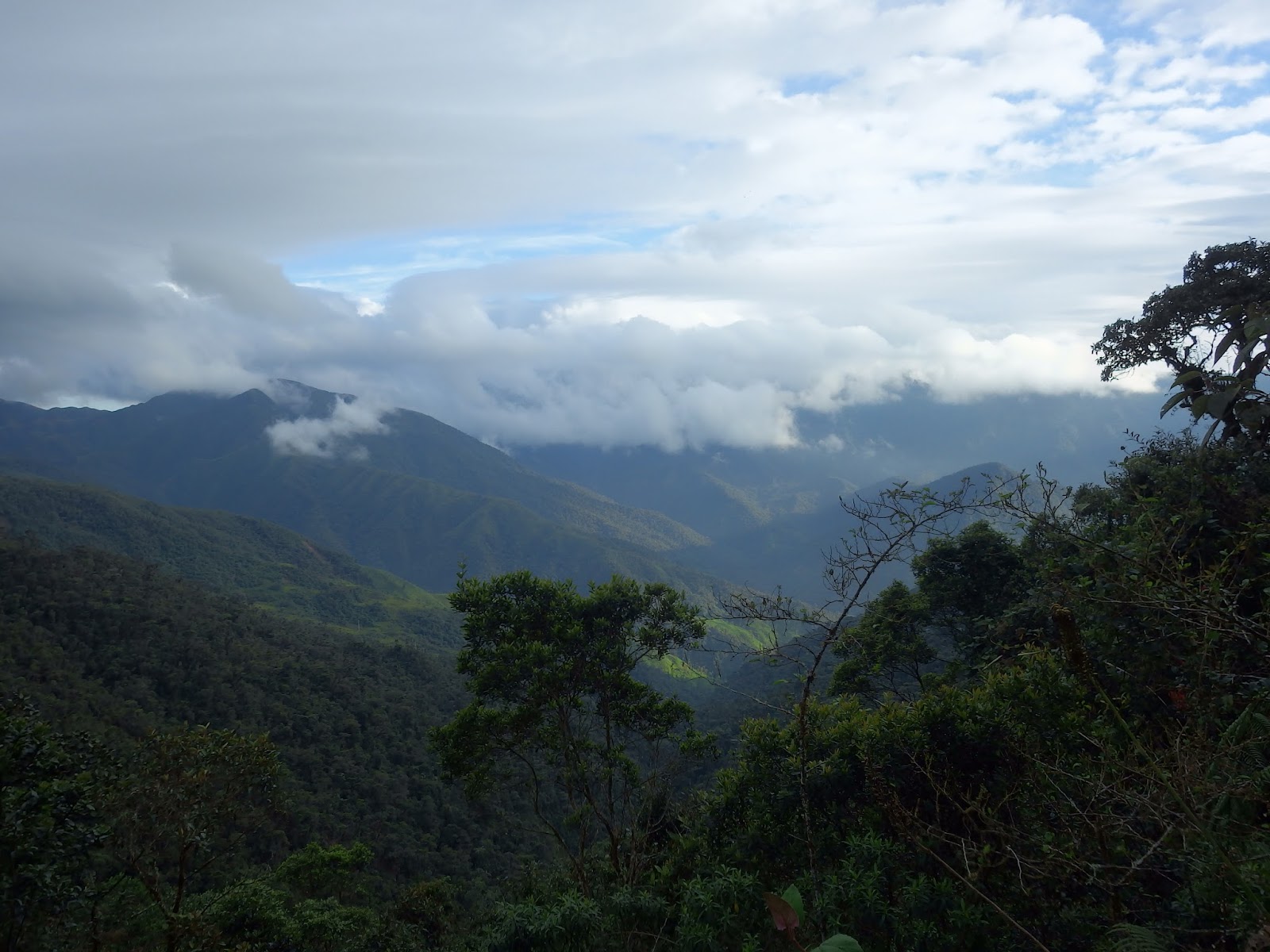
I got there at 6:30 am and birded for 6 hours. Beautiful hooded mountain tanagers and mountain caciques. Hummers everywhere. I spotted and Andean guan as I made my way down the road. I chased a green-and-black fruiteater for 30  minutes. Clouds swirled below me and up the valley. A fantastic day. Had a drink(s) with friends and a steak dinner and off to bed at 8:30.
My next stop will be down to Puyo, one hour east, and at the edge of the Amazon at 3,000 ft. Monkeys begin at appear at that altitude. All different birds. All different smells and flowers. And all different people. Ashuar. Jívaro. Here I come.

The Volcano Tungurahua in clouds


                                                                 Nina and Sunflowers
                                                               Black-tailed Trainbearer

                                                                   Ingapirca


Saturday, November 21, 2015

Macará and Jocotoco Jorupe

Every few days I get itchy to go somewhere. So, on Tuesday I decided to get on a bus to Macará. There are two routes that the buses take and I chose, of course, the wrong one. It was 6 hours on a mostly unpaved road which was still being constructed. The buses are comfortable, the ride was beautiful, but it was tedious travel. This route took me through Cariamanga and Sozoranga. The birding website Birds in Ecuador informed me to look for chestnut collared swallows in Sozoranga. I did not see them. I use that website and its maps for all my birding trips. It is very helpful. Finally, I arrived in Macará. There were few choices for a hotel on Tripadvisor. It is a very small border town. I did, however, choose the best hotel. Hotel Arrozales, named after the mainstay of the town- the rice fields- is a new, modern and clean hotel. I asked the attendant if I could see the room first. Queen size bed, a balcony, large shower with hot water and very clean. For $20. Sold. I changed my shirt and went for a walk. There is an airport which had a closed control tower. It wasn't needed as the people on the runway were not in planes. I suppose it was a remnant from the border wars of 1940 to 1995. It is also very convenient for drug trade. It is in the middle of town and folks sure aren't going to walk around it! I ate a shrimp and rice lunch at a Peruvian restaurant and drank a pitcher of a local drink with a lot of sediment. Delectable for $4.50. One of the first things I noticed about the town was that they like to fly their flags. On the Peruvian side the cows were white and the farmers dressed in red and white. Interesting. There was a futbol game on- Ecuador vs Venezuela- but no one in public places watching it. The girl told me people watch it from home. I could hear the game from every house. I found a new bar called Vino y Tapa and watched the game with a few locals. Ecuador kicked ass. Back at the hotel I asked for a taxi at 6am. They looked stunned. How much. $30. No way. I realised that they had no idea where the Jocotoco reserve was located. " I will call in the morning" she said. In the morning the kid at the desk could not get a taxi. I don't think he knew how to call one. A kid comes walking down the stairs with an expensive  camera on his shoulder and binoculars around his neck. Bingo! "Are you going to Jorupe?" Yes, I said, do you want to share a taxi? "No, I have a car" Bingo again! So off we went at 6:15 am to Jorupe which was only a 10 minute drive. The gate was locked so we walked up to the lodge. It took an hour and we saw lots of great birds. A bat falcon was the most impressive. Thibaud Aronson is from France, about 25, speaks English, Spanish and French,( not a dumb US college kid) and was traveling from Peru with his father. He had to go back to the hotel at 8 to pick up his dad. I stayed and walked the trails. They feed pale-browed tinamou's at the lodge. Nice bird to see. When I got back to the lodge Thibaud was there with his father, Allen, I think, a notable botanist. Again, I meet such interesting people. They dropped me back at the hotel and headed back to Peru. I rested and went for a long walk down to the river at 4pm. Along the way were hundreds of chestnut-collared swallows along the electric lines. They were everywhere. Field workers stared at the gringo with binoculars. Got the birds I was looking for and back to the bar!
Christmas trees are up. They seem to love xmas trees in Macara. They also love manger sets. Very elaborate manger sets. I saw many little baby Jesus's. No xmas music though. Again I asked the hotel to get me a taxi for 6 am. I got one at 6:30 and it was $5 to Jorupe. I walked up to the lodge and birded the trails. Red-billed sythebill. Long-billed starthroat. 13 new species! And the trails are beautiful through the Tumbesian dry forest. The ceiba trees are glorious. Fantastic place. I got back to the lodge and asked the girls to call a taxi and have him pick me up at the front entrance in 1 hour, as that would be how long it would take for me to walk down. At the road I waited almost an hour. No taxi. My blood began to boil. It's hot, I'm tired and I have to walk back up. I gave the girls a piece of my mind I probably should not have shared. I had also learned that I never had to pay $160 a night for a room at Jocotoco lodges. I am a resident and the price should be $60. Now I'm really pissed. I got an email from Paola, who runs the lodges in Quito, saying that those poor girls never had to call a taxi before. Bullshit. When I did have a taxi come- and I made him drive up to the lodge- it wasn't a taxi but some kid with a beat-up car. Paola was upset because she said I called her a liar. She has never given me a straight answer, which is typically Ecuadorian. She offered me a refund which I refused but I told her I would have to reconsider doing business with her. $160 is very expensive as lodges go in Ecuador. And their food is just simple fare. She emphasized that the lower fares are to teach ECUADORIANS. I emphasized that the money for Jocotoco comes from GRINGOS. Which is true. Anyway, I didn't let this spoil my day and got back to the hotel in time to go have a beer. Or 4. And a vino verano. Or 2.
Next morning I caught a taxi at 6:30 and went to the border crossing. This is the only place where you can access the river. The comb ducks are found here. I found 4 of them! Back to the hotel and breakfast- included with the room. I was told that trucks go to Loja and I could catch one in front of the church. I found one and it costs $10 to go to Loja in a brand new 4-door Chevy truck. We would take a different route to Loja. All paved roads. A young couple with a baby also were going and they were in the back seat. The driver was the fastest driver I have had yet. The tires squealed on every curve. The baby was laying on the seat and if he had slammed on the brakes she would probably have needed a new baby. At the police check point they wanted  to see my passport. We were in Loja in less than 3 hours. Speedy Gonzalez gave me his number. It is so easy and cheap to travel here.
A friend of mine here passed away after what should have been an less complicated operation. I'll stay with my Harvard surgeons. Very sorry to see him go.
Now I am waiting on my landlord, who never tells the truth, to come and fix screens. I may move again soon. This house is a little expensive for what it provides. I should stay here and wait out the El Niño event for which the U.S. Embassy sent a warning. It is supposed to be one of the worst ever, especially along the coastal provinces. We shall see. I'm ready to go somewhere again!

Smugmug


Friday, November 6, 2015

Jocotoco Buenaventura

The Jocotoco Reserves are areas where land is purchased in order to preserve certain species of birds. There are 11 reserves, I believe. I went to another reserve for 4 days. The Buenaventura Reserve and the Umbrellabird Lodge are closer to the coast, northwest of Loja. I took a bus to Loja and then the bus to Piñas, a 5 hour trip. My bus driver looked like an Ecuadorian Ralph Kramden. In Loja an indigenous woman asked for the time and I showed her my watch. Then I realised she could not tell time so I told her the time, which I should have done to begin with. In Piñas I took a taxi west for 40  minutes to the reserve. It was a holiday here in Ecuador. The Day of the Dead, when all go visit their relatives stacked in tombs. The bus took a route which carried us over a narrow dirt road for 2 hours. My vertigo has diminished considerably. Along the way I saw folks bathing in the rivers to cool off and wash themselves. I had to close the window on the bus to keep out the dust. It was hot. The sun was bright in town but as we neared Jocotoco in the taxi the clouds descended. I was in the cloud forest again. The muddy road to the lodge was about 5 miles long. As it was a holiday there were many local families visiting the lodge to watch the hummingbirds. Many were trying to touch the birds. Two Coatis came and one shit in the corner. Everyone laughed. I was shown to my cabin and immediately headed out on the trail to bird (verb). White-shouldered tanagers, blue-necked tanagers, club-winged manakins- check! There were birds everwhere. I, I, I say, everwhere. The cloud forests are truely amazing places. The variety of plants and flowers are astounding. At the lodge was Bruce Sherman from Texas. He was in Ecuador to photograph birds. He had an elaborate setup for pictures of hummingbirds. There were 5 flash mounts  on tripods. One of the ladies tried to look through the flash. Bruce dosen't speak Spanish and told her slowly 'it's aaa flaaashh..'  She was a little embarrassed. Bruce seemed  to think if you spoke slowly enough everyone understood English. A 30-something couple from San Francisco showed up at the lodge and Ivan intoduced himself as a board member of Jocotoco. Not much personality. His girlfriend  is an Ecuadorian who has lived in D.C.  The 4 of us had dinner and chatted about the foundation and how they had to split the tour business away from the foundation. Jocotocotours are a separate entity. I was in bed by 9 and up at 5 to meet my guide, Leo. We walked the old road up  to a higher  elevation to look for the El Oro Parakeet, which is one of the birds of special interest. There was a derrumbe which  blocked the path  and I was afraid to try to scale it--- long way down. I dipped on the parakeet as I  did at Tapichalaca and  the golden-plumed  parakeet. I'll git em one day! My guide was a nice guy but not a great birder. I had nice looks  at white-tipped sicklebills and club-winged manakins were abondanza. They make a sound with their wings. Watch one HERE.
The next day I walked the trails alone and saw many more birds. The long-wattled umbrellabird is the most fascinating crow-size bird. The males resonate their calls through the wattle, which is  longer then the bird is tall! I heard  one  calling and tracked him down. Not easy to do in the jungle.
Ivan and his GF departed and were replaced by an older man with white, unkempt hair. A Brit was here. Not your average Brit, mind you, but an O.B.E. Brit! Nigel Simpson is the benefactor of Casa Simpson at Tapichalaca and founder of Jocotoco. A  pharmaceutical chemist who sold the company and gave money to preserve birds in Ecuador. At dinner Bruce wanted to know if Brits liked the Queen. I wanted to know how he came to have a frog named after him. He funded the exploratory project. He was quite interesting and very personable. I enjoyed talking with him.
I stayed an extra night. It is hard to leave the cloud forest jungles. The beauty and strange sounds are enchanting. Eleven  new species of birds. But soon I was back on a bus headed home. A man threw a glass bottle out the bus window and I finally said something. Shame on you, I said.  He wasn't phased.  I'm sick of adults littering here. Shame, indeed.
My porch spider lives. I thought she was dead when I found her dangling from her web one morning. I lowered her to a bush and she climbed under a leaf. Maybe she had just ate her husband and it made her sick. She's better now. She greeted me this morning and had a juicy June beetle to suck on. I'm so glad.


Wednesday, October 28, 2015

Rain Brings a Sigh of Relief

The rain began in the afternoon and lasted through the night. The river trickled over rocks in the morning but by afternoon had overflowed its banks. Five times as much water flowed down from the mountains where it had rained much more. Humidity increased. You could almost feel or hear life cycles enter a growing phase. Insects, reptiles and mammals leave their burrows. Tree limbs, weakened by insects and disease, snap. New sounds emanate from the greenery. Frogs come to life. Time to build nests and webs. Within a few days everything will take on new colors as moss, lichens, mildew, leaves, and flowers grow. Even rocks have different hues and shades of color. I love change. The valley is green again.

 Every night just after dark, a spider starts building her circular web on my front porch.  The web is large and she sits patiently in the middle all night long. Then, at first light, around 4:30, she begins cutting the tie lines. Within a few minutes she and her web are gone. I greet her each morning and evening.

I took a trip to the Jocotoco Tapichalaca reserve. I caught the bus at 6 am and headed south. We picked up school kids along the way and dropped them off at Yangana. These are rural kids, mostly indigenous backgrounds, whose family subsists off the land. Most of them smiling and all of them with the clean, bright white clothes. Their uniforms perfectly clean, tee shirts bright and stainless. The bus driver insisted he knew where I wanted to get off. When we came to Valladolid I told him we passed the reserve and he assured me it was in front of us. I got off the bus and asked if there was a taxi service in the town. No. Then I spotted a taxi coming around the plaza. I called Jocotoco and she explained to him where I wanted to go- 4 miles back. He told me the taxi 

service is new in Valladolid. How lucky I am when I travel! I arrived at the lodge at 8 am and was given a forest-ranger guide. he knew his birds and their calls. After watching them feed the Jocotoco Antpitta, I saw 3 more species of Antpitta- a very reclusive, ground dwelling bird. My meals were excellent and I finally bought a shoulder harness for my binoculars. They no longer hang around my sore neck. The hummingbird feeders were a constant buzz of activity with 5 species coming regularly. At night bats came to feed on the nectar. Amazing. This lodge has camera traps set along the trails and pumas and bears have been photographed. The cloud forest jungles are so breathtaking. So much growth and life abound.  I still dipped on the gray-breasted mountain toucans. Shit, these birds avoid me every time I am in their habitat. I will return and get them. I did see 14 new species (1155). At 11 am the next day I heard the bus coming up the hill and it stopped to pick me up in front of the lodge. I was home in 1.5 hours. So simple. I have forgotten how easy it is to travel in Ecuador. Bus fare was $3. I will be going the to Jocotoco Buenaventura Umbrellabird lodge next week. They are running a special for the holiday- Cuenca's Independence Day. $100 off- sold!

As I get to know some of the locals, mostly U.S. expats but a lot of Canucks and Krauts as well, I am very much aware of how tolerant I have become. Yes, tolerant. Few of the nuts that live here bother me. Just yesterday I was told again about the UFO's that hang over Mandango at night. I hear how safe we are here, away from the Empire and the chemical trails from jets. Honestly, some of these people are certifiably crazy. They take pills to kill all their parasites, then drink booze for 3 hours. Of course everyone has a cure for cancer. Sometimes you have to ask yourself if maybe these are the most intelligent people in the world in my valley and I am the nut. The bird voyueur. They are good people, for the most part.


There is a Halloween party this weekend at Montesuenos. I feel like I should take the invitation and go. I will have to take some B-12 and stay up late. I really don't want to miss my favorite holiday party. The Wood-Logic parties in Atlanta were the best ever, but this could compare. I'll make up my mind Saturday. In the meantime, I am going to a bar to watch the World Series with some friends. He and his wife have a beach house in El Salvador they are trying to sell and it needs painting. I am invited to go with him for a few weeks. Tempting. So is the $350 roundtrip airfare to Sao Paulo, Brazil I saw yesterday. The birds I would tick-off there!Fuck.
Each day I discover something different. A new trail or a new stream or valley. I have squirrel cuckoo in my back yard and something always blooming. I like it here, with my spiders.


Tuesday, October 13, 2015

Another Modest Proposal

As an avid, well, hard-core, bird watcher, I have always slept better if I had gone birding that morning. Indeed, my mood and attitude were more conducive to sleep. Whatever the world's problems were, they weren't mine. I had thoughts of what I had seen that day. Rain or shine, it had been a better day because I had gone birding. As I thought of species that eluded me, I would plan another outing with the determination of finding a certain bird. Hopefully, I would dream of birds or other wildlife. I now live in Vilcabamba, Ecuador, in the midst of the greatest diversity of life on the planet. If you are searching for birds, plants or orchids, animals or reptiles, it just does not get any better than Ecuador. My walk this morning took me from dry scrub to wet cloud forest in just an hour. One couldn't help but smile at such surroundings. An article in The Atlantic for October, 2015, describes the benefits of such activity. Not birding, per se, but any activity which brings you into an environment conducive to tranquility and awe. They call it ecotherapy. It can be the best prescription for many ailments or conditions. It can alleviate stress (hormonal) and behavioral disorders. We are an animal ourselves and we must affiliate ourselves with other life forms. Nature-deficit disorder exists! Thoreau understood this, as did E. O. Wilson. Children are more at ease after time spent communing with nature. Patients heal faster if their hospital room has a view of nature. You have less anger, fatigue or sadness if your workout is in a park, or the woods, rather than in a gym. But you can't just touch a tree and incur the benefits, you also have to have a sense of caring or feel involved. You, as a life form, are a part of this environment. You don't have to wear tie-dye and live in a commune to appreciate the benefits of nature. I propose that this be incorporated in a childs' education at the appropriate age, which I would leave to educators to determine. I am not saying take kids out to a park and have them smell the flowers. They need to be taught how to appreciate their surroundings and have a sense of belonging. Ecuadorians have a propensity to litter which could be alleviated if they are taught at a young age that trash has its place, and this place is not along the side of the road. All the populace should have this appreciation instilled in them. As a tool, teaching bird watching skills is an ideal way to accomplish this goal. It can have a set curriculum. And if you like to learn names of the birds you see, it can teach you something about Latin! Every aspect of what a child might learn by birding has multiple benefits. A teacher could 'sneak' in the science of biology and chemistry with ease. Ask someone to donate 20 pairs of binoculars to a school. Surely a corporation in your area would like to sponsor this type of education. Nature-deficit disorder can sometimes lead to a teenager picking up a few cans of spray-paint!

John W. Erickson

Vilcabamba, Loja, Ecuador.